Liberia’s health system and the case for one connected patient record
Liberia’s health system has made progress in recent years, but much of its clinical and reporting work still depends on paper and on facilities that operate in isolation from one another.
Those conditions slow clinical decisions, duplicate work across facilities and increase the risk of preventable error. This perspective sets out why connecting the health system on a single patient record should come before digitising each facility on its own, and how the Moana platform is designed for those conditions. Moana Digital Health’s work with Liberia is at the engagement stage.
Current conditions
Much of Liberia’s health system continues to rely on:
- Paper based patient records
- Handwritten prescriptions
- Delayed diagnostics and reporting
- Hospitals, laboratories and pharmacies that do not share information
The consequences are slower clinical decisions, work repeated from one facility to the next, higher operating costs and a greater risk of preventable medical error.
Limited infrastructure compounds these pressures. Only part of the population has reliable internet access, and there are few physicians relative to the population. Any health information system for Liberia must work within those constraints.
Connection before digitisation
Digitising facilities one at a time does not by itself improve continuity of care. A patient record held electronically in one hospital remains unavailable to the laboratory, pharmacy or referral hospital that needs it next. The greater opportunity for Liberia is a health information system in which facilities share one record per patient, so that information recorded at one point of care is available at the next.
Such a system needs to:
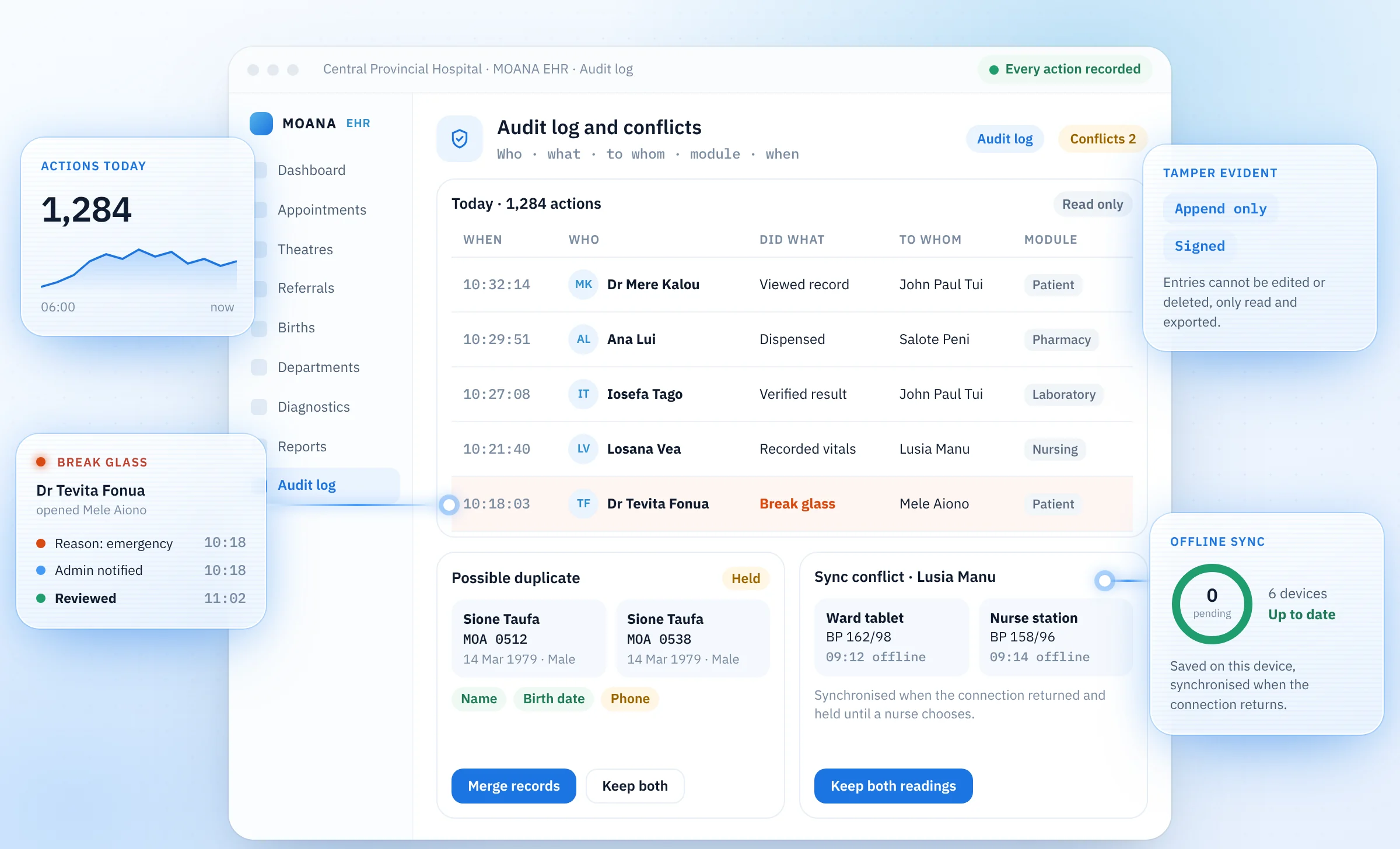
- Continue working when connectivity is unreliable, and synchronise when the connection returns
- Connect clinics, hospitals, laboratories and pharmacies on the same record
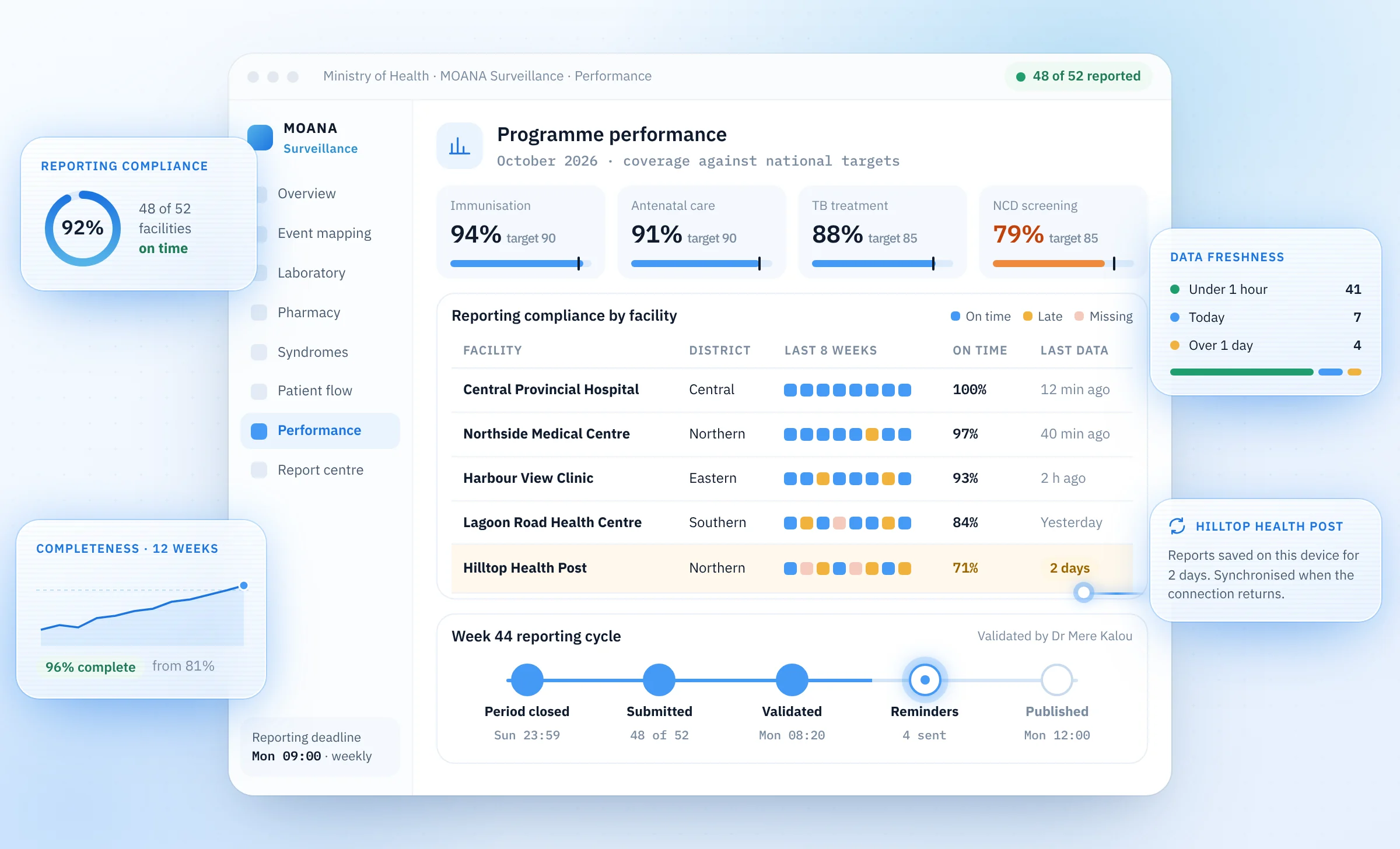
- Produce reporting from routine clinical documentation rather than separate tallies
- Remain under the ownership and data governance of the government that operates it
The Moana platform
Moana is an electronic health record and health information system designed for these conditions. Its design rests on five principles:
- Designed for unreliable connectivity, with work saved on the device and synchronised when the connection returns
- One record per patient across every stage of care
- Medication safety at the point of care, including interaction checks before a medicine is dispensed
- Interoperability through international standards, including HL7 FHIR R4, ICD 10 and LOINC
- Operational visibility of beds, appointments and patient flow for facility managers
Roles across the care team
On a shared record, each member of the care team works from the same information:
- Doctors review and update the patient’s full history in one place
- Nurses record care and track patient progress against the same record
- Laboratories return results to the record that ordered them
- Pharmacies dispense against the prescription and maintain medication records
- Administrators oversee operations and patient flow
The clinical pathway
Moana supports the patient pathway as a single connected sequence:
- Patient registration
- Consultation
- Laboratory and imaging orders
- Results returned to the ordering clinician
- Prescribing with interaction checks
- Treatment and medication administration
- Discharge and follow up
Each step is recorded once, by the person carrying it out, and is available to every clinician involved in the patient’s care.
Design considerations for Liberia
For a health system in Liberia’s position, the platform is designed to:
- Operate in settings where connectivity is limited or intermittent
- Be learned quickly by frontline health workers
- Scale from an individual clinic to a national system
- Support long term sustainability under government ownership
National reporting drawn from routine care also gives planners and policy makers information that reflects the care actually delivered, rather than figures compiled separately at month end.
Conclusion
Liberia’s health system faces real constraints in connectivity, workforce and infrastructure. A health information system that connects facilities on one patient record, works within those constraints and remains under national ownership offers a practical basis for coordinated care. Moana Digital Health’s engagement with Liberia is directed at that objective.